- By Admin
- 01 Dec, 2025
- Share

Why Abacus Is the Best Tool to Connect Your Childs Left and Right Hemispheres
Every parent wants their child to be sharp, confident and happy in studies. Marks are important, but so are clear thinking, good memory, problem-solving and creativity. All these depend on one key factor: how well both sides of your child’s brain work together.
The abacus may look like a simple frame with beads, but in trained hands it becomes a powerful tool to connect the left and right hemispheres of the brain. This whole-brain connection helps children learn faster, stay focused and feel more confident, especially in maths.
Understanding Your Child’s Left and Right Brain
Our brain has two halves, called the left hemisphere and the right hemisphere. The left side handles logic, numbers, language and step-by-step thinking, while the right side deals with imagination, pictures, patterns, emotions and creativity.
In regular schooling, most tasks are left-brain focused: reading textbooks, solving sums, writing exams and memorising definitions. The right brain, which loves images and stories, often gets less exercise. The child may still score marks, but inside they can feel stressed, bored or afraid of subjects like maths. When both sides are equally active and connected, children understand faster, remember longer and enjoy learning more — and this is the balance abacus training supports.
What Happens When Only One Side Is Active
Think of a child who spends most study time memorising tables and writing sums. Their left brain gets plenty of practice, but the right brain is hardly used. Maths slowly begins to feel heavy and dry, and the child may start believing, “Maths is difficult,” or “I am not good at numbers.”
Now imagine a child who mostly colours, plays and does creative work, with very little structured or logical practice. They may be imaginative but struggle to follow steps, plan time or solve problems in order. In both cases, one side of the brain becomes strong and the other weak. When only one hemisphere is active, children may become over-analytical and stressed, or very creative but disorganised. Real success needs balance, and abacus training brings this balance by pulling both hemispheres into action at the same time through one simple-looking activity.
How Abacus Becomes a Whole-Brain Gym
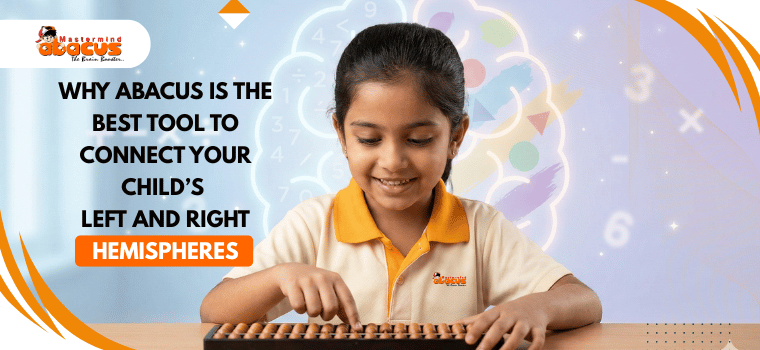
At first sight, an abacus is just a frame with beads. But when a child starts using it to calculate, many parts of the brain switch on together. The child has to look at the beads carefully, move them with the correct fingers, follow calculation rules and keep track of numbers in their mind. This turns every practice session into a whole-brain workout.
The left hemisphere becomes active because the child is handling numbers, methods and correct answers. It works step by step and checks whether the solution is correct. At the same time, the right hemisphere views the beads as patterns and pictures — noticing the shapes and positions as the beads move. During abacus practice, both sides of the brain stay active and keep communicating with each other. Over time, this continuous communication builds strong brain connections, resulting in faster thinking, clearer understanding and a more confident approach to learning.
From Beads in Hand to Beads in the Mind
Abacus learning usually begins with a physical abacus. The child touches the frame, feels the beads and moves them again and again. This builds a strong link between hands, eyes and brain and becomes the base for later mental work.
After some time, when the child is comfortable with the real abacus, they move to the next level called mental abacus. Now the abacus is inside their mind. The child closes their eyes, imagines the frame and beads and moves those imaginary beads to solve sums — still reaching the right answer. They are using logical rules of maths but doing it with mental pictures. The left and right brain work together like a team, and this mental imagery improves memory, focus and imagination in a disciplined way.
Changes Parents Notice in Everyday Life
Parents cannot see brain connections, but they can see behaviour. After a few months of abacus practice, many notice that their child is faster in maths. Children take less time to add or subtract, make fewer mistakes and depend less on fingers or calculators.
For example, many parents share that their child now finishes a full page of addition in half the time they used to, and often without counting on fingers.
Focus also improves. Children who were easily distracted now sit for longer periods without losing attention. They complete homework with more interest and need less pushing from parents. Many start answering more questions in class because they feel surer of themselves. These benefits are not limited to maths. As both hemispheres become better connected, memory, observation and problem-solving skills improve in other subjects too.
Beyond Maths: Emotional Strength and Confidence
Brain balance does not affect only intelligence; it also shapes emotions. Many children quietly fear maths and think they are slow or “not a maths person.” This belief damages confidence and stops them from trying.
Abacus changes this experience. It turns maths into something closer to a brain game. Children enjoy seeing their own progress and feel proud when they can solve sums quickly, sometimes even faster than adults. The inner voice changes from “I am weak in maths” to “I am good at numbers.” A child who feels strong in one difficult subject often carries that courage into other areas. They are more willing to try new things, speak up in class and face tests with a cooler mind.
Why Abacus Matters in a Screen-Filled World
Today’s children grow up surrounded by screens. They watch videos, play games and use apps for many hours. Even when apps are educational, they mostly involve only the eyes and sometimes the ears. The body is still, the hands do very little and the brain is not deeply engaged.
Abacus gives a refreshing, screen-free change. The child must move their hands, use their voice, look carefully and think actively. This physical and mental involvement is excellent for building strong connections between both hemispheres. It also prevents children from becoming dependent on gadgets for every small calculation. In a world that is getting more digital every day, a strong, well-balanced brain is one of the best gifts you can give your child — and abacus helps build exactly that kind of brain.
Give Your Child the Gift of a Connected Brain
Your child’s brain is still growing and creating new pathways every day. This is the best time to support that growth in the right way. Abacus is not just about doing sums faster. It is about connecting the left and right hemispheres so your child can use their full brain power.
Your child’s brain is growing fast — this is the best time to build strong skills. Abacus online classes don’t just improve speed in maths; they connect the left and right brain, helping children think smarter, remember better and grow more confident.
A small step towards online abacus training can create big changes in focus, creativity and overall brain development. Help your child become sharper and more capable with expert abacus online classes.
Frequently Asked Questions
1. How does abacus help the brain?
Abacus makes kids use numbers and imagination together, so both sides of the brain stay active and work as a team.
2. Is abacus only for fast maths?
No. It improves focus, memory, confidence and thinking skills along with maths speed.
3. What is the right age to start?
Most children can start between 5–12 years, when the brain is growing quickly.
4. Does mental abacus really work?
Yes. Children imagine the beads in their mind and solve sums mentally — and they get the right answers too.
5. When will I see improvement in my child?
Usually within 2–3 months — faster sums, better focus and more confidence in studies.
Author – Naveen Chowdhari
Naveen Chowdhari is the Founder & Owner of Mastermind Abacus, a leading name in children’s mental math and brain development training. By blending traditional abacus methods with modern teaching techniques, he has created an innovative system that enhances children’s concentration, memory, visualization, speed, and overall cognitive skills. Under his leadership, Mastermind Abacus now provides worldwide online abacus classes and has built a strong global franchise network, making quality brain-development education accessible across the world.
Last Updated: 31 January 2026
.png)


Speak Your Mind